By Joe Budzelek (@JBudzelek)
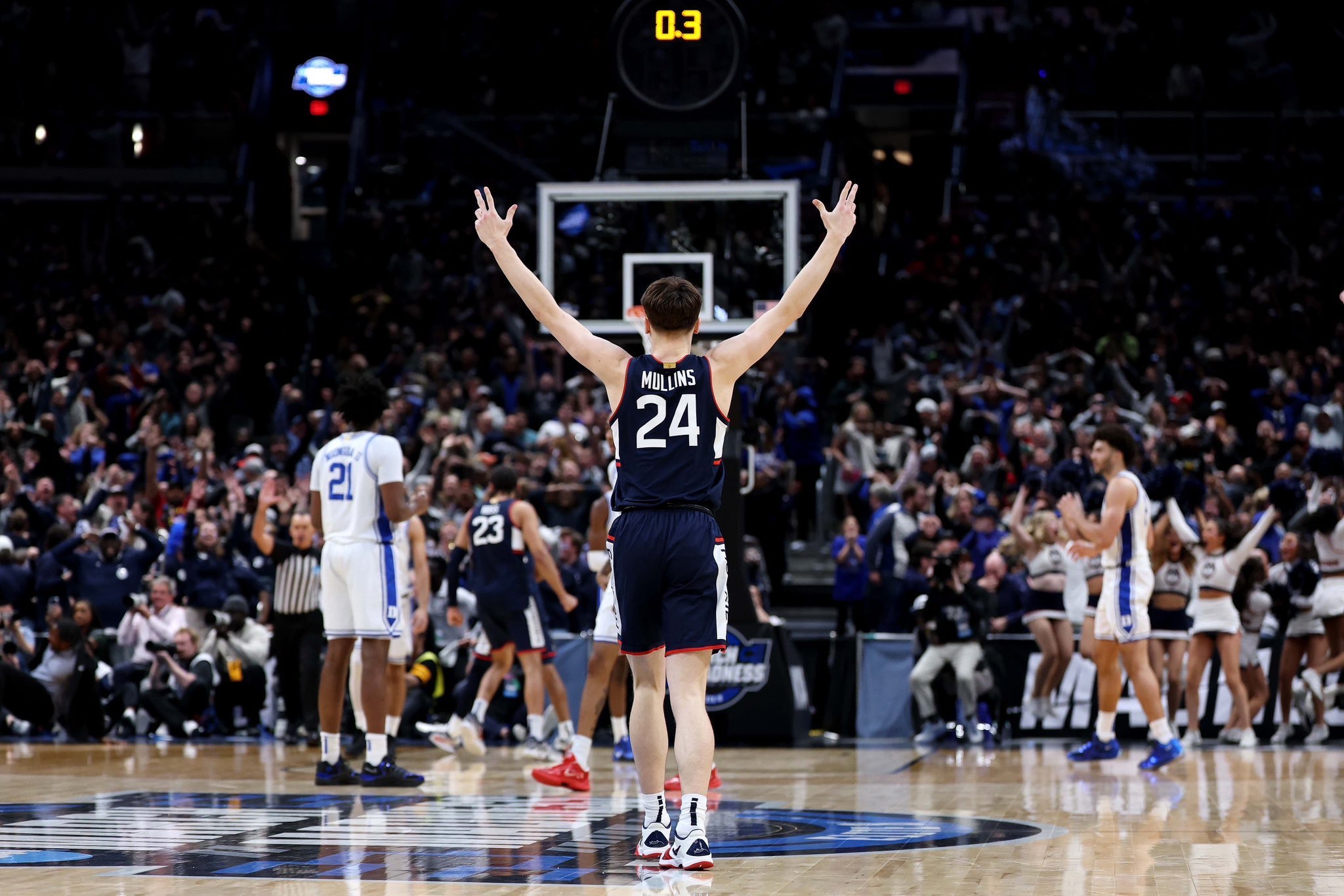
There is no shortage of motivation for Duke heading into Wednesday night’s rematch with UConn. The Blue Devils were 0.4 seconds away from another Final Four appearance last March before watching a 19-point lead disappear in one of the most memorable finishes in NCAA Tournament history. Silas Demary, Jr.’s miraculous defensive tip set up the Alex Karaban-to-Braylon Mullins-and-back sequence, culminating in Mullins’ prayer of a three-pointer that sent UConn to the Final Four.
UConn gradually took control in the second half, using its physicality, defensive pressure and ability to capitalize on Duke’s mistakes to turn what appeared to be a comfortable victory into a devastating 73-72 loss for the Blue Devils.
Jon Scheyer has had to reload considerably since last season, particularly with the departures of Cameron Boozer, Maliq Brown, Isaiah Evans and Nik Khamenia, but Duke is hardly starting over. The Blue Devils retained an important foundation in Patrick Ngongba II, the team’s leading scorer, rebounder and shot-blocker; Cayden Boozer, who leads the team in assists; Dame Sarr, the team’s steals leader; and senior guard Caleb Foster. They also added considerable experience through the transfer portal in Wisconsin’s John Blackwell, while 7-foot-2 freshman Joaquim Boumtje Boumtje brings tremendous upside to the frontcourt as he continues to mature. Boumtje Boumtje is the youngest player in college basketball and won’t turn 18 until May.
The biggest difference this season is the composition of Duke’s talent. Last year’s team was built around Cameron Boozer’s extraordinary ability to create offense and dominate possessions. This group places a greater emphasis on ball movement and attacking the basket, particularly given its early struggles from three-point range (28 percent). As a result, the offense has not approached last season’s elite efficiency.
Defensively, however, Duke remains formidable thanks to the playmaking, toughness and versatility of its frontcourt. Shot blocking has been a particular strength, with Ngongba, Boumtje Boumtje and freshman seven-footer Cameron Williams all posting excellent block rates. Ultimately, the foundation of this team’s defensive identity lies in its size and rim protection.
A look at Duke’s starting lineup
Cayden Boozer – 6-4, 195, sophomore guard
A pass-first point guard who is comfortable operating in the pick-and-roll, Boozer is at his best facilitating and scoring inside the arc, as he has yet to develop into a consistent three-point threat. Thanks to his active hands, size, physicality and instincts, Boozer is also one of Duke’s most well-rounded backcourt defenders.
John Blackwell – 6-5, 205, senior guard (transfer from Wisconsin)
After averaging 19 points per game at Wisconsin last season, Blackwell has struggled considerably with his efficiency this year, making just 27 percent of his two-point attempts and 29 percent of his three-point attempts across Duke’s three most challenging matchups against Michigan State, Illinois and Washington State. At his best, he’s a physical scoring guard who can create his own shot, score at all three levels and close games by attacking downhill, drawing fouls and getting to the free throw line. His strong frame and physicality also make him capable of defending multiple perimeter positions.
Dame Sarr – 6-8, 200, sophomore forward
Long and athletic, Sarr has done a nice job this season playing to his strengths, transitioning from an inefficient catch-and-shoot option as a freshman to a more downhill, interior-focused scoring threat. He’s also developed into a more effective kick-out passer. Duke’s most intriguing perimeter defender, Sarr takes up considerable space and plays with excellent anticipation, making him one of the team’s best defensive playmakers.
Patrick Ngongba II – 6-11, 250, junior forward
Last season, I classified Ngongba as a rock-solid center, but the junior has added considerable nuance to his game and developed into a star. Currently ranked by EvanMiya.com as the ninth-most valuable player in college basketball, Ngongba is a smooth interior scorer with excellent footwork who can finish in pick-and-roll opportunities and operate as a passing option from the high post. An aggressive defender who blocks shots and moves well for his size, Ngongba is also an excellent rebounder on both ends of the floor.
Joaquim Boumtje Boumtje – 7-2, 250, freshman center
There’s a reason the youngest player in college basketball is already considered an early favorite to be the top pick in the 2028 NBA Draft: Few 7-foot-2 players combine Boumtje Boumtje’s two-way instincts, perimeter shooting upside and elite physical tools. Understandably, given his age, he can occasionally become a black hole offensively, but he has also shown flashes of point center-facilitating ability in international competition. As he gains more experience at the college level, his development will be particularly interesting to follow.
Duke’s key rotation players
Caleb Foster – 6-5, 200, senior guard
A starter last season, Foster has transitioned into a versatile, plug-and-play bench piece who can handle any of the three backcourt positions. Duke’s most consistent perimeter shooter, Foster is also an unselfish facilitator with enough strength to attack off the dribble and score in the paint, although his 64-percent free throw shooting remains a weakness. He’s a valuable secondary offensive option, though his defense can be targeted.
Sebastian Wilkins – 6-8, 220, sophomore forward
After reclassifying from the 2026 to the 2025 recruiting class, Wilkins redshirted last season and now shares some similarities with Sarr. Both athletic 6-foot-8 wings can generate turnovers defensively and are dangerous attacking downhill. Wilkins’ aggressive defensive instincts can occasionally lead to overpursuing, however, which compromises his overall efficiency.
Deron Rippey, Jr. – 6-3, 185, freshman guard (five-star recruit)
Explosive, quick and athletic, Rippey has offset his offensive struggles with disruptive on-ball defense. He has the tools to eventually develop into a lead guard, but for now, he’s primarily a defense-first backup who provides energy and perimeter pressure.
Drew Scharnowski – 6-10, 240, senior forward (transfer from Belmont)
Currently ranking in the top three percent nationally in rebounding rate and top percentile in two-point percentage, Scharnowski moves exceptionally well for his frame. He’s a versatile defender who can switch, defend in space and provide valuable help-side resistance. Offensively, he’s also an excellent passer from the high post.
Cameron Williams – 7-0, 215, freshman forward (five-star recruit)
A mobile, athletic seven-footer with considerable 3-and-D upside, Williams is still developing the strength and bulk necessary to battle consistently against physical interior players. He’s already shown promise as a weak-side rim protector, however, and gives Duke another intriguing defensive option in the frontcourt.
Keys for UConn:
While Duke has tremendous individual size and talent, it hasn’t yet developed the collective physicality and offensive identity necessary to consistently impose its will. The Blue Devils have shown vulnerability against teams willing to challenge them physically and attack the paint. In their loss to Michigan State, the Spartans consistently found opportunities around the basket, while Illinois outscored Duke 48-30 in the paint. Even with a significant size advantage against Washington State, Duke managed only a four-point edge in paint scoring.
If those issues are compounded by Duke’s continued struggles from long range, UConn’s defense has an opportunity to exploit those weaknesses and create one-and-done possessions. The Huskies should be particularly aggressive on the offensive glass, where Duke has shown some vulnerability, while making the Blue Devils prove they can consistently win from the perimeter.
Defensively, both Michigan State and Illinois found openings in Duke’s transition defense and defensive rotations, particularly when they were able to break down the initial coverage and attack the paint. That presents an intriguing opportunity for UConn’s backcourt. Braylon Mullins and Silas Demary, Jr. have the ability to create matchup problems throughout the half court, whether through their individual shot creation, penetration or ability to capitalize on defensive breakdowns.
Ultimately, UConn needs to bring the same physicality, defensive pressure and composure that allowed it to erase a 19-point deficit last March. Duke has the size and talent to make this a difficult matchup, but the Huskies have a blueprint for how to challenge the Blue Devils.
Leave a Reply