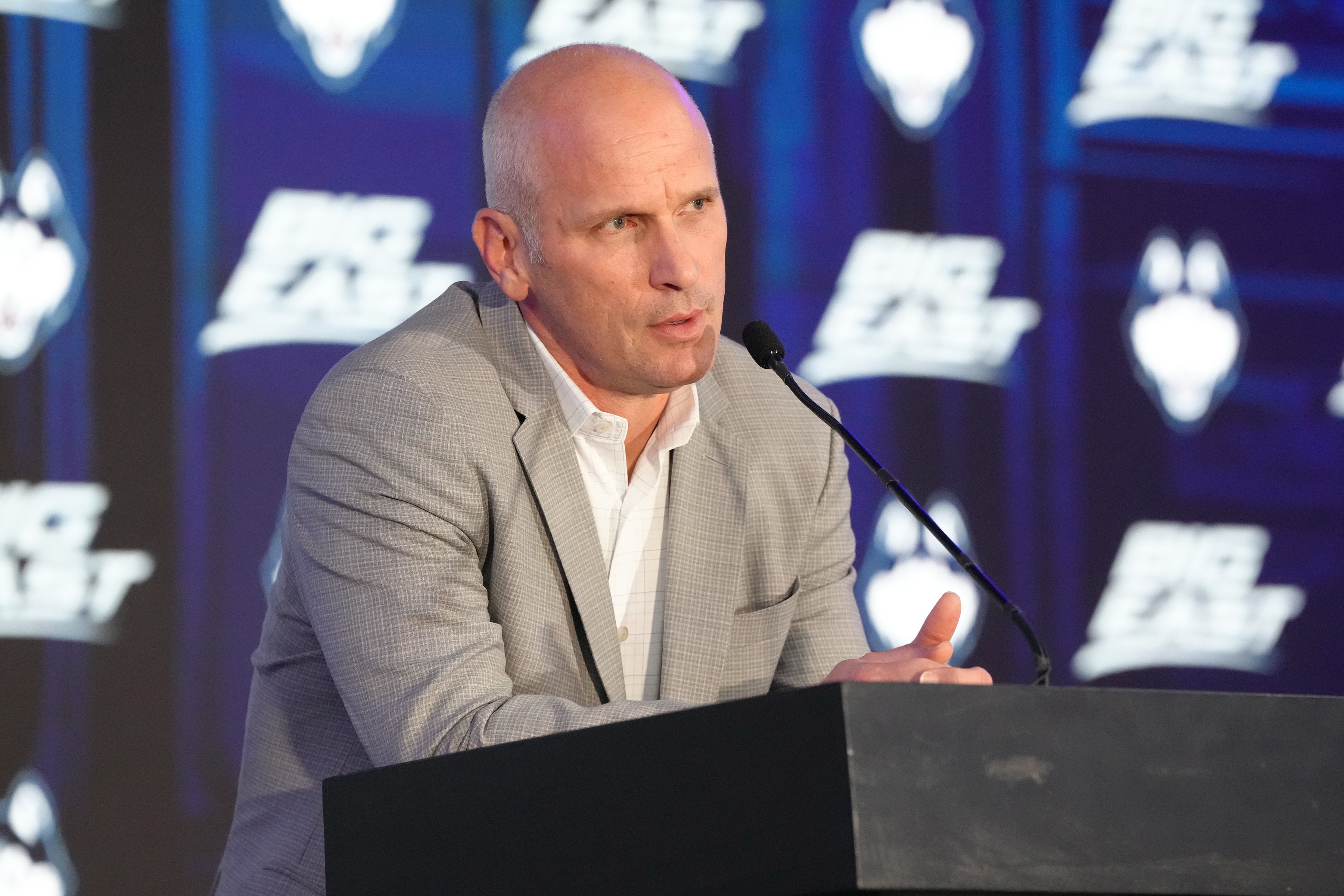

NEW YORK — At Big East media day last October, Dan Hurley was candid in addressing his mental health struggles and a burnout that left the UConn head coach “completely cooked” at the conclusion of the 2024-25 season.
Hurley chronicled his quandary in his book, Never Stop: Life, Leadership, and What It Takes to Be Great, revealing that the aftermath of the Huskies’ second-round NCAA Tournament exit left him contemplating stepping aside from the reins in Storrs to recharge his battery. Last season, the 53-year-old returned to the Final Four, bringing UConn to the doorstep of a third national championship in four seasons before falling six points short against Michigan. The coach conveyed tangible pride in the result and the season despite the loss, calling the outcome “a soldier’s death” against the physical, athletic Wolverines.
The soldier that stood valiant but vanquished outside a locker room in Indianapolis six months ago is donning the helmet and armor once again, his battle beginning anew as UConn surveys the landscape of a new season with the same heightened expectations that have accompanied the Huskies since their back-to-back title-winning exploits of 2023 and 2024.
“It never stops,” Hurley quipped last Thursday at Big East media day before an overflow crowd at UConn’s breakout session. “You’ve gotta have, if you coach college basketball or college football, your character, your coaching stamina. You’re basically CEO of UConn basketball, right? You’re the tactical coach, the offensive coordinator, you’re the defensive coordinator, you’re the (general manager), you’re the president. You’re everything. And it’s 11-and-a-half months a year. It never stops.”
UConn was voted as the preseason favorite to win the Big East Thursday, receiving eight first-place votes in the conference’s coaches’ poll. For Hurley, notoriously dismissive of prognostications, the recognition is merely a reminder of the exorbitantly high standard at one of college basketball’s most tradition-rich winners. But deeper within the projected order of finish lies a process-driven, oftentimes maniacal mastermind whose strategizing had already gotten underway the moment he returned to the self-proclaimed basketball capital of the world this past April.
UConn’s offseason, not unlike most other programs, was fraught with roster upheaval and a revolving door of personnel movement. The Huskies graduated five players, with two of them — Alex Karaban and Tarris Reed, Jr. — hearing their names called in the first round of June’s NBA Draft, then saw five others transfer out of the program for other opportunities. And of the five players that stayed, one (Jacob Ross) redshirted last season, with another being unavailable for this coming campaign after Solo Ball underwent offseason wrist surgery, leaving just Silas Demary, Jr., Braylon Mullins and Jayden Ross as the sole incumbents on the roster.
Hurley and his staff worked feverishly in the transfer portal, grabbing a pair of marquee players in Na’jai Hines and Nik Khamenia, both of whom played against UConn at Seton Hall and Duke, respectively. The familiarity allowed Hurley to get a more intimate feel for what each would bring to the Husky table before fortifying the bench with pickups the likes of Oskar Giltay, Nils Machowski, Jaye Nash and Isaiah Shaw, plus incoming freshmen Junior County and Colben Landrew.
“We want to be younger,” Hurley shared. “We would like to coach players that are going to do multiple years with us. As core transfer players, I think it was very appealing (that) a Na’jai Hines, an Oskar, a Nik Khamenia, that they were freshmen becoming sophomores, young players that potentially could play for multiple years at UConn. And I think we look at the back end of our roster, some of those depth pieces to be kind of older players with a year left of college that want to experience UConn basketball.”
“Six of our first nine impact players are going to be guys we either recruited out of high school, are in their second year at the program, or are young transfers.”
Hurley’s unbridled competitive spirit is such that the preparation for a new season sometimes consumes him before the current season is over, a trait he attributes to his blue-collar Jersey City upbringing. His fight-or-flight mentality remains permanently fixed on the former, owing whatever sacrifices occur along the way to casualties of war. Now more than a year removed from perhaps his most intense and costly internal battle, one in which he emerged victorious, the warrior takes on his next challenge with a clear head but the same conscious objective.
“We’re in a time right now where we’re trying to figure out the best way to run a basketball organization in a landscape where there’s no rules or regulations,” he cautioned. “So it’s kind of not the easiest time for you to run a basketball organization where you don’t know what the rules are, but what we’ve gone with is just staying true to who we are, which is culture, player development and trying to keep our program young with players that’ll wear the uniform for multiple years.”
“I hate uncertainty, like most people. I’d rather go through the pain of coaching an 18-year-old every day. Just how much patience you have to have, that’s also incredibly rewarding.”
Leave a Reply