
By Joe Budzelek (@JBudzelek)
On the surface, there are plenty of reasons for Yale to look different this season.
The Bulldogs lost Nick Townsend, their leading scorer and the reigning Ivy League Player of the Year, along with several other key pieces from a team that won its second consecutive Ivy League regular season championship and earned its fifth consecutive postseason berth. In addition to Townsend, reigning Ivy League Defensive Player of the Year Casey Simmons also graduated. Second team all-Ivy selection Isaac Celiscar transferred to Baylor after finishing second on the team in scoring, rebounding, assists and blocks last season, while erstwhile starting center Samson Aletan has gone up I-95 to join Providence and its first-year head coach, Bryan Hodgson.
For most programs, that kind of turnover would signal the beginning of a rebuilding year.
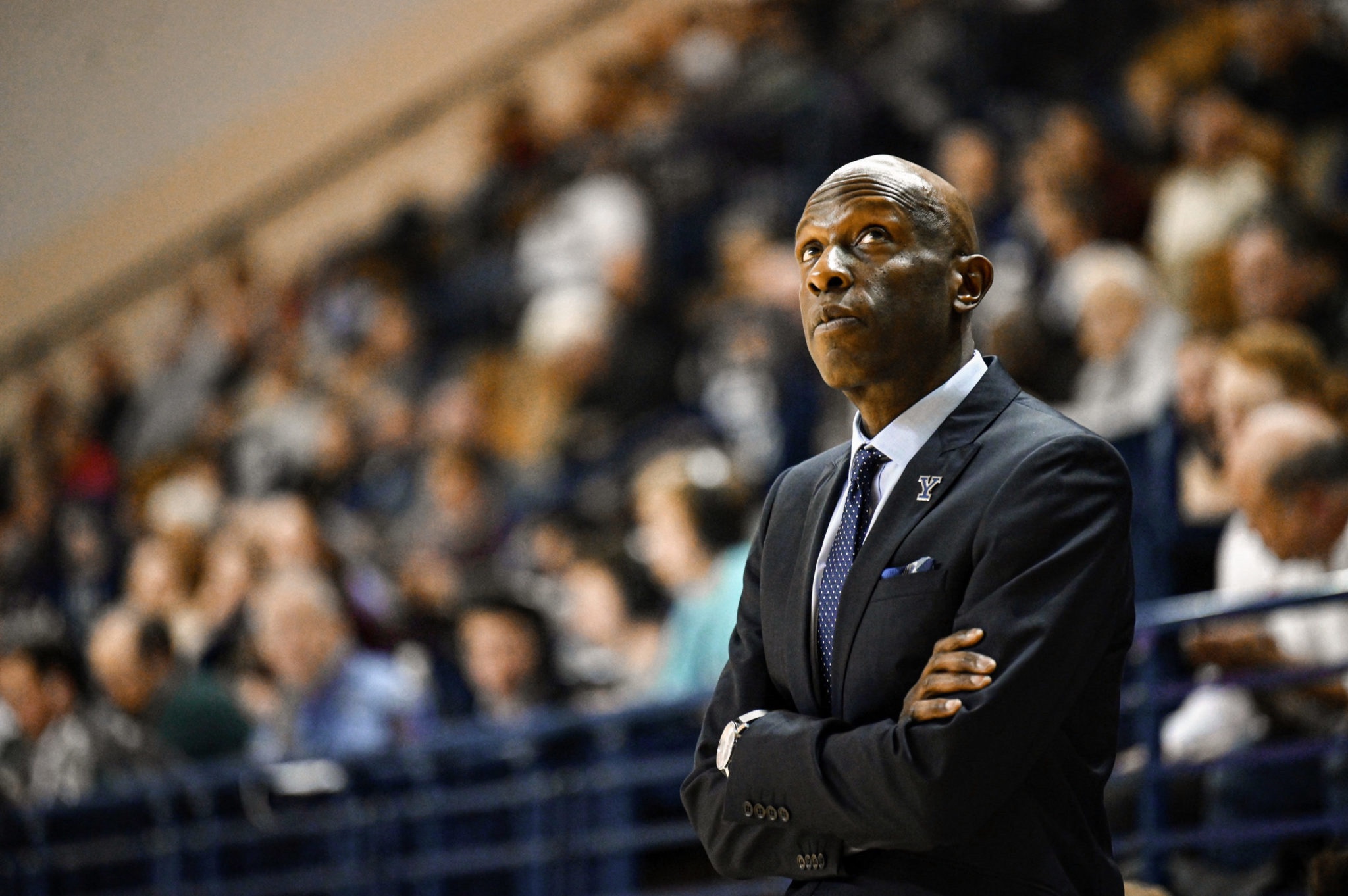
James Jones doesn’t see it that way.
The veteran Yale coach has been through this before. After significant turnover following the 2019-20 season, the Bulldogs went on to win the Ivy League championship the following year, with Paul Atkinson and Azar Swain emerging as the team’s top two scorers while Eric Monroe and Jalen Gabbidon stepped into full-time starting roles.
“Prior to the 2019-20 season, we lost four starters — three to graduation and Miye Oni leaving early for the NBA Draft — and we came back and won the championship the next year,” Jones said. “So there’s always somebody in the ranks ready to step up. This year’s roster offers a similar opportunity. We have guys who didn’t play much at all last year, like Jack Sullivan, Courtney Wallace and Alvin Loving, who will have more of an opportunity this coming year. They’re really good players that no one knows about, I guess, except for us.”
That belief in the players already within the program will be tested early, but Jones isn’t looking for one player to simply replicate what each of last year’s impact departures brought to the team. Instead, Yale’s offense could evolve around a group with even more players capable of stretching the floor.
“I think we were one of the best three-point shooting teams in the country, and dare I say, we have the potential to be even better this coming year,” Jones said. “I think we have more guys who are able to stretch the floor and shoot the three than we did last year, so it’s going to be really interesting to see how that comes together.”
Senior guard Trevor Mullin and juniors Riley Fox and Jordan Brathwaite are Yale’s top three returning scorers, with each shooting at least 37 percent from three last season. Connor May, meanwhile, shot nearly 40 percent from three last year as he arrives from Division III powerhouse Washington University in St. Louis after earning third team All-American honors as a sophomore. May led the Bears in scoring (17.3 points per game), rebounding (7.2 rebounds per game), steals and blocks. Jones believes May’s toughness and basketball IQ will translate to the Division I level, giving Yale another versatile piece to work with.
“A lot of times, there are misnomers about college basketball players, and I’ll tell you that the best Division III players can certainly play at the Division I level,” Jones shared. “That’s been proven time and time again, and Connor is certainly one of those guys. He has a very high basketball IQ and a great sense of toughness, and those two areas will certainly help him at this level. I think he’s probably along the lines of a Nick Townsend-type athlete, kind of a blue-collar guy who is going to position himself, rebound and work through some toughness to get to where he needs to be.”
Mullin, meanwhile, enters his senior season as Yale’s only returning starter. He earned all-Ivy tournament honors after producing the best two-game stretch of his career in the Bulldogs’ run to the conference championship, scoring 43 points and dishing out seven assists. In April, Yale announced that Mullin would serve as the team’s captain this season.
“Trevor’s role has expanded every year that he’s been here, and now it’s time for him to take another step in a more positive direction for us, both on the court and off the court with his leadership,” Jones said. “He has a really high basketball IQ as well. I see a bigger chip on his shoulder right now.”
The Bulldogs’ versatility extends into the frontcourt, where Jones has a number of options competing for minutes. In addition to May and returning sophomore Jack Sullivan, 6-foot-10 freshmen Jonas Oware and Tim Winkler, 6-foot-9 freshman Brady Wooley and 6-foot-6 freshman Chris Bolte all bring perimeter skills to a group that could give Yale plenty of flexibility up front. Sophomore Daniel Ogunyemi, a 6-foot-7 forward, will also compete for minutes.
“We have a lot of options, and I’m certain that somebody will make an impact from day one,” Jones said. “Who that person is right now is really hard to say, but we have six guys in the frontcourt, and we can move Riley Fox and Chris Bolte over there if we wanted to. So we have a lot of options up front, and I’m sure someone’s going to step up — cream rises — and we’ll see who that is. I’m sure all our guys are excited to prove that they’re the guy, and they’re all going to have their chance.”
While improved spacing could create more opportunities in the open floor and force opposing defenses into difficult matchups, the bigger question may come on the other end of the floor. Yale was able to rely heavily on its ability to defend the post one-on-one last season while using a relatively simple ball screen defense. With a different collection of personnel this year, Jones doesn’t expect to have quite the same luxury.
“I think there will be some challenges this year,” he admitted. “We were able to guard one-on-one in the post last year, and I’m not certain that we’ll be able to do that for the entire season. We primarily used one ball screen defense, and I don’t know that we’ll be able to do that this year.”
That could force the Bulldogs to become more creative defensively while maintaining the same core identity that has helped them win two straight Ivy League titles.
“We just want to be really good defensively, be a really good rebounding team and be a really good assist team,” Jones said. “That’s who our identity is.”
For Jones, the challenge isn’t creating a new identity. It’s figuring out how this particular group can best embody the same one. That process will likely take some time. For fans in search of familiarity, Mullin, Fox and Brathwaite will look to take the next step as leaders, while sophomores Courtney Wallace and Alvin Loving IV will compete for key minutes in the backcourt. Yale has enough shooting to potentially make up for some of its lost offensive production, but the Bulldogs will need players who spent last season on the periphery to become reliable contributors as Jones searches for the right combinations at both ends of the floor.
Even with Penn and Harvard returning the most talent in the Ivy League, the expectations for Yale haven’t changed. The Bulldogs finished third or better in the conference in each of the last 13 seasons, including consecutive regular-season championships. The Bulldogs won’t have the luxury of sneaking up on anyone, even with a roster that looks considerably different from the one that celebrated in March.
Jones has navigated that kind of roster turnover before. And if his history with the program is any indication, he believes the next group is already waiting in the wings.
“There’s always somebody in the ranks ready to step up,” he said.
Leave a Reply