By Jackson Gross (@JGrossReporter)

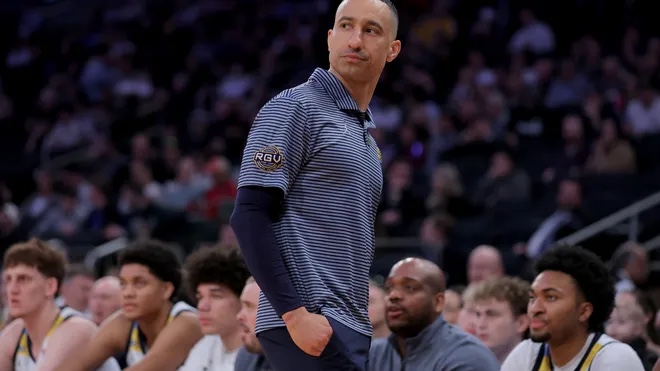
Ever since Shaka Smart arrived at Marquette, one of his principles has been to avoid making a big splash in the transfer portal, opting to develop his guys and roll with them, wearing it as a badge of honor.
It worked for the first four seasons of his tenure, as the Golden Eagles compiled a 98-41 record, four straight NCAA Tournament appearances including a Sweet 16 Appearance, a Big East regular season and tournament championship in 2022-23, four players drafted to the NBA for the first time since Henry Ellenson, and a return to national prominence in the college basketball scene. Yet, going into 2025, most of the pieces that had built those squads were gone, with Chase Ross and Ben Gold the sole remaining players from those days. Marquette relied much more on young players than in years past, and it led to the program’s first losing season under Smart, finishing 12-20, including a six-game losing streak midseason.
Despite that ugly mark, that’s not to say the Golden Eagles didn’t have any bright spots. Nigel James, Jr. broke out as a star, as he averaged 16.4 points, 4.9 assists and 3.4 rebounds per game, and shot 47 percent from the field and 34.7 percent from three-point range. In the final 13 games of the season after Marquette ended its six-game losing streak, James averaged 20.1 points, 5.9 assists, 4.3 rebounds and 2.4 steals per game en route to being named the Big East Freshman of the Year.
In an attempt to avoid a second straight losing season and complement his star guard, Smart finally dipped into the portal for the first time since his first season, picking up a Milwaukee native in junior guard Nolan Minessale from St. Thomas and senior big man Sananda Fru from Louisville. With the new infusion of talent, combined with the returning pieces for the Golden Eagles, Smart has given Marquette a shot to get back into the top half of the Big East.
Transfers
Marquette made the first of its two big transfer portal splashes on April 15, with Jonathan Givony of Draft Express reporting that Sananda Fru was heading to Milwaukee. The 6-foot-11 Berlin native (yes, that Berlin) was ranked as the seventh-best transfer player according to Draft Express after his one season at Louisville. In his first collegiate season, Fru put up 9.0 points, 6.1 rebounds and 1.2 assists per game. Yet, when you take a look at some of his advanced numbers, you can see why Marquette targeted him to solve some of its issues in the paint.

Getting offensive rebounds was a major problem for the Golden Eagles last season; per Bart Torvik, they gave up 34.7 percent of potential offensive rebounds in 2025, ranking 332nd in the nation. Fru should provide a big help in that regard, as his 14.9 percent offensive rebounding rate ranked 27th nationally. As much as Marquette fans liked Ben Gold’s ability to space the floor at times, it couldn’t be denied that he struggled to shoot at the rim with regularity. He did convert shots on the rim at a 68.4 percent clip, but only took 33 percent of his shots at the tin, with 64 percent coming from behind the three-point line, per CBB Shot Charts. Compare that with Fru, who shot 78.9 percent at the rim with a whopping 89 percent of his shots coming from there. Defensively, he also provides a bit more athleticism and swatted more shots at the rim with 1.4 blocks per game.
Just five days later, on April 20, Marquette completed a homecoming for Minessale, who grew up in Brookfield and played his high school ball at Marquette University High School. While there, Minessale totaled 22.1 points, 6.6 rebounds, 4.6 assists and 1.6 steals per game, shot 60.1 percent from the field, and led the Hilltoppers to their first state title since 1999. Growing up as a Marquette fan, Minessale spoke with reporters last month about what it’s been like for him to be with the Golden Eagles now.
“It’s been very surreal, just growing up and going to all the games,” he said. “My parents had season tickets growing up, so I’ve always been a huge fan. It’s just been really great to be here. I’m super happy, and I’m super excited to have the opportunity to play for Marquette.”
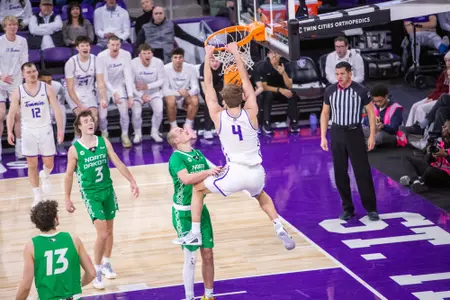
Before he donned the blue and gold, he went north to Minnesota to play in the purple and white of the St. Thomas Tommies. During his first two seasons, he played and started in all 68 games. While he was solid as a freshman, scoring 11.2 points per game, his sophomore season is when he really popped off. His scoring jumped to 19.8 points per game, and he averaged 4.6 rebounds, 4.3 assists, and 1.6 steals per game. His performance earned him a spot on the all-Summit League team, the Summit League All-Defensive team, and the all-tournament team as the Tommies made it to the semifinals as the No. 2 seed. They ended up losing to eventual conference champion North Dakota by one, 67-66, after Austin Herro (yes, that’s Tyler Herro’s brother) turned over the ball and Carter Bjerke fouled George Natsvlishvili with less than one second on the clock.
Minessale will provide a reliable scoring option next to James, shooting 50.6 percent from the field, 63.3 percent at the rim (53 percent of his shot diet) and 30.6 percent from beyond the arc (33 percent of his shots). He’ll likely slot in as the starting two guard or the three, next to Adrien Stevens and James. Outside of his pure basketball ability, he’ll act as a necessary release valve and secondary ball handler next to James so that the sophomore floor general doesn’t lead the Big East in usage rate at 30.1 percent, as he did this past season.
Returning Players
The Golden Eagles have a lot of returning young talent, some of whom we may see for the first time in their collegiate careers. Yet, let’s start with the players who’ve already suited up in blue and gold from a year ago.
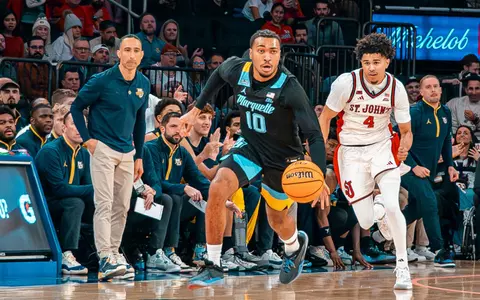
Adrien Stevens, in the second half of the season, really became the Robin to Nigel James’ Batman. In the first 19 games of the season, Stevens averaged a meager 5.9 points, 2.1 rebounds, 1.3 assists and 0.9 steals per game, and shot 43.5 percent from the field and 37.3 percent from three-point range. Then, in the final 12 games of the regular season, things started to click for Stevens on both ends of the court. His averages and shooting numbers skyrocketed across the board, averaging 11.3 points, 3.2 rebounds, 2.0 assists and 2.3 steals per game while shooting 46.5 percent from the floor and 41.8 percent from beyond the arc. His mini-breakout on both ends of the floor made him an excellent fit next to James in the backcourt. While he didn’t end his freshman season on the best note in Marquette’s Big East tournament loss to Xavier, shooting 2-for-12 (1-for-10 from deep), he’s certainly part of a new core that can take the Golden Eagles to the next level this season.
The third member of that three-person core is junior forward Royce Parham. While he was part of the Big East All-Freshman team, his sophomore campaign was a big step in his development. Parham jumped his scoring average to double digits at 12.5 points per game while grabbing 4.9 rebounds per contest and shooting 52.2 percent from the field and 33.3 percent from three. He even had a nine-game stretch of scoring in double digits after he was placed into the starting lineup with Zaide Lowery missing the rest of the season (including a career-high 26 at Villanova), in which he averaged 17.4 points per game and shot 63.3 percent from the field. Parham picked up the slack, and his ability to space the floor will make life in the paint much easier for Fru and give Marquette arguably its best rebounding bigs under Smart.
The last two returning players who saw significant playing time are Caedin Hamilton and Damarius Owens. Hamilton did start the first 15 games of the season for the Golden Eagles, but had limited success. The Santa Maria, California native averaged just 4.3 points and 4.1 rebounds per game before being replaced by Ben Gold in the starting five. His production dipped even further in the final 12 games once he started coming off the bench, playing just nine minutes per game and scoring just 1.3 points and 1.5 rebounds per game. Hamilton is coming into his fourth year with the program (he redshirted as a freshman), and has to start showing he belongs in high-major basketball. If he can’t get on the floor with a team that needs big-man minutes, then he may go the way of Emarion Ellis and transfer to a smaller Division I school.
The last of the big returners is Damarius Owens. After a relatively quiet freshman season, he stepped into a bigger role and even started one game as the Golden Eagles dealt with several injuries throughout the season. The one game he was thrust into the starring five, on February 24 against Georgetown, he scored 11 points in Marquette’s 76-60 win. He’s an athletic player with some pretty good tools to utilize, but his clear weakness is three-point shooting, with a poor 29.7 percent career mark. If he wants to make another jump in his game, he needs to start hitting shots from outside with some regularity.
There are three other returning players who either didn’t get a lot of playing time or were redshirted in 2025-26. Michael Phillips did play over 220 minutes last season (8.0 per game), and finished the season on a high, scoring a career-best 10 points off the bench. Despite the limited playing time, he did show some chops as a shooter (17-for-46 from deep), and that will easily get him some more playing time this season. Joshua Clark played three games as a freshman before getting redshirted for the rest of the season, then playing in 23 contests last year. At 7-foot-1, Clark has the size to be a solid bench center in his sophomore season, but needed another offseason of development before he gets a bigger role with this team. The last is Ian Miletic, who redshirted his freshman season. The last time we saw the former Rolling Meadows Mustang play was during the IHSA playoffs, where he averaged 25 points per game. He did see some run in the Golden Eagles’ tour of Canada, but scored a grand total of three points across three games and 31 total minutes, shooting just 1-of-9 from the field. We’ll see how much run he gets once the season gets underway, but it’s not an encouraging start for the former no. 1 recruit out of Illinois.
2026 Projection
This will still be a growing year for this Marquette squad, but I liken it to the second year of a rebuild. This team will be more competitive, and I think the Golden Eagles have a real shot to finish in the top six in the Big East. Heck, even with all the ups and downs of last season, they finished one game back of DePaul for sixth, so with an improved roster, a Top 6 finish shouldn’t be out of the question at all. If Marquette can do that, then it’s a great step in moving the program closer to the glory days of Smart’s early years, when Tyler Kolek was the starting point guard.
There will be growing pains early on as Marquette tries to integrate new players who should see significant playing time, coupled with a strong non-conference schedule. Marquette will take on Wisconsin, Missouri, Mississippi State, and reigning national champion in Michigan before getting into the weeds of conference play, dealing with the likes of St. John’s, UConn, and Villanova. Yet, as we’ve seen in years past, Smart can raise the talent level of his team when he has his type of veteran players.
The key to Marquette’s season will be developing its young players and how they mesh with the two big transfers. While there will be some patience with this roster in the early going, the expectation is and should be a return to the top half of the conference standings, a win or two in the Big East tournament, and fighting for a spot in the NCAA Tournament.
Leave a Reply